

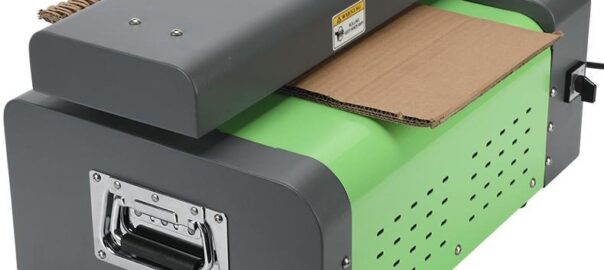

Most warehouses and fulfillment centers generate a steady stream of cardboard waste. Once a shipment is unpacked, the box often ends up flattened in a recycling bin or, less ideally, discarded as trash. For years, the default approach was to buy void fill separately—plastic air pillows, foam peanuts, or bubble wrap—while discarding cardboard that could have served the same purpose. The X70, X71, and X72 carton cutting machines from Eco Pack Machinery are designed to close that loop by converting waste cardboard into reusable protective material directly at the packing station.
These machines are sometimes referred to as cardboard shredders, but their primary function is controlled cutting and slitting that transforms corrugated board into a mesh-like or strip-cut output. The result is a flexible, compressible material that works well as void fill, cushioning, or light wrapping. For operations trying to reduce plastic consumption, lower packaging costs, and keep useful material out of the waste stream, this type of equipment solves several problems at once.
What the X70, X71, and X72 actually do
The core job of these machines is straightforward: feed a piece of corrugated cardboard into the inlet, and the machine processes it into an expanded, cut format that can be used immediately for packing. The cardboard should ideally be clean and dry, and thickness limits vary by model. The output is not a fine shred or mulch; it is a structured cut that retains the strength of the corrugated layer while becoming pliable enough to nest around products inside a shipping box.
This matters because not all “shredded” material is useful for packaging. If the output is too rigid, it does not conform to the product. If it is too fine, it shifts and settles during transit. The cutting action on the X70–X72 series is tuned to produce a practical intermediate—material that stays in place, absorbs shock, and can be reused or recycled again after delivery.
Key differences between the three models
While the machines share the same basic function, they are sized and specified for different workloads and cardboard formats.
- X70: Cutting width up to 325mm, max thickness around 10mm, 200W power, speed up to 3m/min, compact footprint (approx. 45×30×27cm), weight about 30kg. This model fits well at packing benches with moderate volume and smaller cardboard sheets.
- X71: Cutting width up to 425mm, max thickness around 6mm, 400W power, speed up to 3m/min, larger body (approx. 55×30×27cm), weight about 33kg. The wider cut is useful when processing broader sheets or larger box panels, while the slightly lower thickness capacity keeps the focus on common single- and double-wall board.
- X72: Cutting width up to 500mm, max thickness around 6mm, 400W power, speed up to 3m/min, larger frame (approx. 65×30×27cm), weight about 38kg, CE certified. The 500mm width makes it the most versatile for bigger cardboard sheets, and the CE certification supports compliance documentation in regulated purchasing environments.
All three models operate on 110–220V, which simplifies integration into most facilities without special electrical upgrades. The debris collection systems included with these machines also help keep the packing area cleaner by catching dust and offcuts at the source.
Why operations teams invest in this type of equipment
The decision to bring a cardboard cutting machine into a packing area usually comes down to a few practical drivers:
- Waste reduction with immediate payoff: Cardboard that would be flattened and recycled can instead be converted into packaging material used the same day. That reduces the volume of waste leaving the dock and the volume of void fill entering the warehouse.
- Lower recurring packaging spend: By generating a portion of void fill on-site, operations can reduce purchases of plastic pillows, foam, or imported paper fill. The savings become more noticeable at higher order volumes.
- Simpler sustainability messaging: Using recycled cardboard as packaging material is easy to explain to customers and aligns with common recycling expectations. It does not require new behavioral change on the customer side—curbside recyclability remains intact.
- Faster, more consistent packing: Having a cutter near the packing bench shortens the step where packers hunt for the right size filler. The material is produced on demand, in the amount needed, and it behaves predictably in the box.
- Cleaner, safer workstations: Centralized cutting replaces scattered utility-knife work on cardboard with a single machine that handles the task more consistently and with fewer loose offcuts on the floor.
Where these machines fit best
They are commonly used in e-commerce fulfillment, 3PL packing stations, manufacturing shipping areas, retail backrooms, and any environment where incoming goods arrive in corrugated cases that can be repurposed. They are not intended for heavy-duty board beyond their rated thickness, and they are not a substitute for balers or industrial shredders that process large volumes for recycling streams. Instead, they sit at the packing station level, focused on immediate reuse.
Implementation considerations that affect results
To get consistent value from the X70–X72, most teams find it useful to set a simple workflow: flatten incoming boxes, remove excessive tape or labels when possible, feed sheets into the machine, and stage the output near the packers who need void fill. Keeping a small bin or shelf for the cut material helps maintain flow. Regular blade maintenance and keeping the debris tray emptied are minor tasks that preserve cut quality and reduce downtime.
The bigger operational point
Packaging efficiency is often improved not by a single dramatic change, but by removing small frictions that repeat hundreds of times a day. A cardboard cutting machine does not look like high-tech automation, but it changes a recurring task from “discard and buy replacement filler” to “convert and reuse.” Over time, that shift tends to show up in lower material costs, less waste, steadier packing speed, and fewer plastic inputs—without complicating the packer’s job.
For businesses evaluating the X70, X71, or X72, the practical question is not whether cardboard can be cut, but whether a specific model matches the sheet sizes, thicknesses, and daily volumes moving through the packing area. When the fit is right, the machine usually earns its place quickly by making better use of material that was already on hand.