


For the past several years, the conversation around packaging has been dominated by surface-level talking points: “go green,” “reduce plastic,” and “improve the unboxing experience.” These are valid goals, but for operations managers, procurement officers, and packaging engineers, the real decision-making process is far more grounded in operational reality. The question is not whether sustainability matters—it clearly does—but how to implement sustainable packaging without slowing down the line, increasing labor costs, or compromising product protection.
At Eco Pack Machinery, we work with warehouses, 3PL providers, manufacturers, and e-commerce fulfillment centers that face these trade-offs every day. Many of them come to us after realizing that their current protective packaging methods—plastic bubble wrap, foam peanuts, air pillows, and manual cutting—are creating hidden inefficiencies that scale badly as order volumes grow. The solution they are looking for is not a marketing slogan. It is reliable equipment that integrates cleanly into existing workflows and delivers measurable improvements in speed, consistency, material usage, and workplace organization.
This article lays out the operational case for moving to paper-based protective packaging systems, the types of machinery that make it practical, and the factors that determine whether the investment actually pays off on the floor.
Why Protective Packaging Becomes a Bottleneck as Volume Grows
Protective packaging is one of those functions that looks simple when volumes are low and becomes a constraint as soon as throughput increases. In small operations, a packer with a utility knife, a roll of bubble wrap, and a roll of tape can manage. But at higher volumes—hundreds of orders per day, multiple shifts, seasonal spikes—the same tasks start to expose structural weaknesses:
- Inconsistent wrapping and void fill lead to variable protection and occasional damage claims.
- Manual cutting and measuring consume more time per order than most teams realize until they track it.
- Bulky plastic consumables take up storage space and create constant restocking logistics.
- Mixed materials (plastic wrap plus paper boxes) complicate recycling guidance for end customers and create cleanup work on the packing table.
- Ergonomic friction adds up when packers are pulling, cutting, stretching, and taping repetitive materials all day.
None of these issues necessarily break the process at low volume. But together, they form a ceiling on how efficiently a packing area can operate. Paper-based protective packaging systems are not popular simply because they are “eco-friendly.” They gain traction because, when paired with the right machinery, they tend to simplify the work, reduce mess, and make output more predictable.
What “Paper-Based Protective Packaging” Actually Includes
In practice, paper-based protective packaging covers several distinct functions that used to be handled by plastic or foam. The three most common are:
- Void fill and cushioning (replacing plastic air pillows, foam peanuts, and bubble wrap)
- Wrapping and surface protection (replacing bubble wrap and foam sheets)
, 3. Box resizing and cardboard preparation (replacing manual utility knives and improvised cutting)
Each of these functions can be supported by dedicated machinery that produces the protective material on demand, at the packing station, in the amount needed for the task at hand. This “on-demand” model is what changes the economics. Instead of storing multiple SKUs of pre-made plastic fillers and wrappers, a facility can store kraft paper rolls and honeycomb paper rolls, and convert them into protective output as orders move through the line.
Honeycomb Paper Dispensers: Replacing Bubble Wrap with a Structured Paper Web
Honeycomb paper has become one of the most practical replacements for plastic bubble wrap in sectors that ship fragile items: glassware, ceramics, electronics, cosmetics, bottles, and delicate components. The material starts as a flat kraft paper roll and is converted—either manually or mechanically—into a stretched honeycomb structure that interlocks and cushions.
Eco Pack Machinery offers both electric and manual honeycomb dispensers to match different volumes and workstation setups.
- The X80 Electric Honeycomb Paper Dispenser is designed for higher-throughput packing stations. It dispenses honeycomb paper up to 510mm wide at speeds around 8 m/min, with a 50W motor and a compact footprint (approximately 60×33×12 cm). It is the kind of machine that sits on a packing bench and becomes a natural part of the wrap-and-fill motion packers already use.
- The X90 Manual Honeycomb Paper Dispenser serves lower-volume stations, remote packing points, or businesses transitioning into paper-based packaging without committing to powered equipment. It handles up to 510mm width, requires no electricity, and is compact and portable (around 63×20×21 cm, 6.5 kg).
From an operational standpoint, the value of honeycomb dispensers is not only that the output is paper-based and recyclable. It is that the material behaves predictably: it stays where you put it, it interlocks, it does not static-cling to everything nearby, and it does not require inflation or sealing. For many packers, that alone improves packing speed and reduces rework.
Paper Cushion Machines: On-Demand Void Fill Without Plastic Air Pillows
Void fill is one of the most common sources of wasted space, wasted material, and wasted time. Plastic air pillows solve the volume problem but introduce others: they inflate with a machine, they shift inside boxes, they pop under sharp items, and they are often rejected by curbside recycling streams depending on local rules.
A paper cushion machine like the X60 changes the approach by converting Z-fold kraft paper into padded cushions on demand. The machine supports paper widths around 340mm, runs at speeds up to roughly 10 m/min, and has a compact benchtop footprint (about 45×26×27 cm). It is CE certified and designed for continuous use in fulfillment environments where packers need fast, clean, and consistent void fill.
The operational advantages are straightforward:
- You store paper rolls, not pre-inflated plastic pillows.
- You produce the length you need, when you need it.
- The output is curbside recyclable in most markets.
- The cushion stays in place better than lightweight plastic pillows, especially in mixed-load boxes.
For e-commerce operations processing a wide variety of SKUs and box sizes, this flexibility tends to reduce both over-packing and under-packing, which in turn reduces damage rates and material waste.
Carton Cutting Machines: Removing the Utility Knife from the Packing Line
One of the most underestimated inefficiencies in packaging areas is box resizing and cardboard preparation with utility knives. It is slow, inconsistent, and—perhaps most importantly—ergonomically poor and safety-prone. When you multiply a few extra minutes per box across hundreds of daily orders, the labor cost becomes real, and the quality variance becomes a process risk.
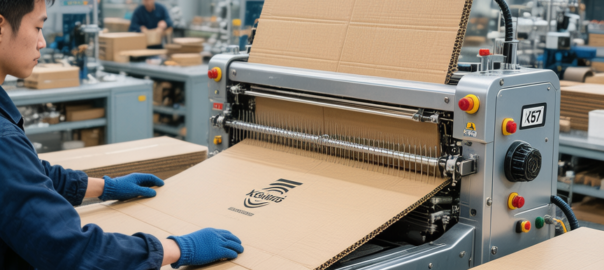
Eco Pack Machinery’s X70–X75 carton cutting machines are built to replace utility-knife work with repeatable, low-effort cutting.
- The X70 is a 200W, 30 kg unit with a 325mm cutting width and up to 10mm thickness capacity—suited for general carton resizing and cardboard sheet prep.
- The X71 increases width to 425mm (optimized for <6mm thickness) and moves to 400W.
- The X72 offers 500mm width, CE certification, and a blade designed to handle tough jobs (including cutting through nails in paper, a common reality with recycled board).
- The X73 steps into higher throughput with a 1500W geared motor, 12 m/min speed, and up to 10mm thickness—built for busier lines where cutting cannot be the slowest step.
- The X75 is the heavy-duty option: 2200W, up to 20mm thickness, 12 m/min, 50cm width, and a 200 kg build that stays put under load.
Across these models, the practical benefits are consistent: cleaner cuts, less physical effort, reduced blade changes, and integrated debris collection that keeps packing tables cleaner. For operations that modify boxes to right-size shipments (and reduce void fill in the process), these machines tend to pay back quickly in labor efficiency and reduced rework.
Ancillary Equipment That Completes the Workflow
A packaging workstation is rarely just one machine. Eco Pack Machinery also supplies equipment that supports the surrounding tasks:
- Air column bag inflating machines (e.g., Q20) for operations that still use air bags for certain products, with compatibility for 15–100cm rolls and a requirement for an external air compressor.
- Induction sealing machines for bottles and containers, supporting mouth sizes from 15–130mm and touchless sealing for plastic or glass.
- Roll holders and winding desks (e.g., ZL-5000) to manage large material rolls cleanly and at adjustable heights.
- Auto cushion systems with overhead hoppers and sensors for automated film feeding in higher-integration lines.
These tools matter because packaging efficiency is often lost in the transitions: unwinding a roll, feeding a machine, clearing offcuts, repositioning materials. Thoughtful support equipment reduces those micro-delays that accumulate across a shift.
The ROI Question: What Buyers Should Evaluate Before Purchasing
A 2000-word article could easily list more specifications, but the more useful exercise for a buyer is to frame the evaluation around operational variables that actually affect ROI:
- Throughput per packing station
How many orders per hour must each packer handle? Where does protective packaging prep fit in that cycle?
- Material variety and box size mix
High SKU counts usually benefit more from on-demand systems than from pre-made filler SKUs.
- Storage and inventory constraints
Rolls of paper typically store more compactly than equivalent volumes of plastic pillows or foam, but roll handling and accessibility still matter.
- Labor consistency and training
Simple, intuitive machines reduce training time and variability between shifts and staff members.
- Damage rates and returns
Protective packaging is not only a cost; it is a control variable for damage. Small improvements in consistency can reduce expensive claims.
- Local recycling expectations
In markets where customers expect curbside recyclable packaging, paper-based outputs reduce friction and support brand positioning without adding complexity at the packer level.
- Equipment reliability and support
For machinery that sits on the packing line, uptime matters more than fancy features. Frame durability, motor choice, blade life, and accessible support are what keep the line moving.
Why This Shift Is Not Just a Trend
There is a difference between a short-term trend and a structural change in how packaging operations are built. The move toward paper-based protective packaging is increasingly the latter because it aligns three pressures that are not going away:
- Regulatory and compliance trends that push reductions in plastic use and improvements in recyclability.
- Operational pressures to make packing lines faster, cleaner, and less dependent on high-touch manual steps.
- Customer expectations that packaging should be easy to dispose of responsibly and should not feel like waste.
Machinery is the enabler that makes this shift realistic at scale. Without it, “sustainable packaging” often means more manual work, more material juggling, and more inconsistency. With the right equipment—honeycomb dispensers, paper cushion machines, carton cutters, and the supporting accessories—paper-based protective packaging becomes the smoother, faster, and more controllable way to run the line.
Closing: Packaging as Operational Infrastructure
For companies evaluating packaging machinery in 2026 and beyond, the smartest question is not “Is paper better than plastic?” but “Which systems help our packing area run better—faster, cleaner, safer, and more predictably?”
At Eco Pack Machinery, the goal is to provide equipment that answers that question on the floor, not just on a spec sheet. Whether it is an X80 honeycomb dispenser at a high-volume packing bench, an X60 paper cushion machine reducing void-fill guesswork, or an X73 cutter removing the utility knife from the workflow, the common thread is practical improvement: less friction, less waste, and more consistency per order.
If you are reviewing packaging equipment options and want to match machinery choices to your actual order profiles, box sizes, and throughput targets, the most useful next step is usually a straightforward one: look at the packing process as it is, identify where time and material are being lost, and choose the machine that removes that loss without creating new ones.